
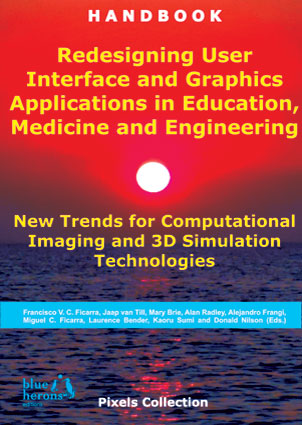
Redesigning User Interface and Graphics Applications in Education, Medicine and Engineering: New Trends for Computational Imaging and 3D Simulation Technologies
:: Pixels Collection ::
:: Revised Selected Chapters ::
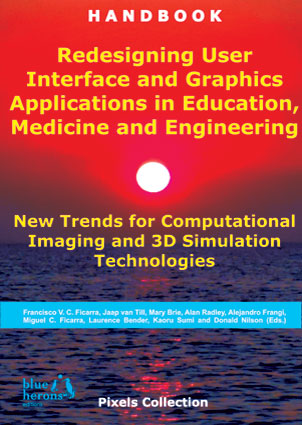
Main Editor: Francisco V. C. Ficarra
Co-editors: Jaap van Till (Amsterdam, the Netherlands), Mary Brie (La Valletta, Malta), Alan Radley (Blackpool, UK), Alejandro Frangi (Manchester, UK), Miguel C. Ficarra (Spain and Italy), Kaoru Sumi (Hakodate, Japan), and Donald Nilson (Oslo, Norway)
Editorial Assistants: Amélie Bordeaux (Lyon, France) and Luisa Varela (Perpignan, France)
Book Details
• ISBN: 10979-12-80096-06-7 :: DOI: 10.979.1280096/067
• Publisher: Blue Herons Editions
• Location: Italy (Bg)
• Subjects: 3D, AI, Computer Animation, Computer Graphics, ICT, Medicine, MR, VR, Web
• Subjects: CAD, Computer Vision, Emulation, GAI, Hardware, HCI, Simulation, Software
• Subjects: Communicability, Education, Engineering, Information, GIS, ML, Video Games
• Subjects: Design, Gardunia Factor, Human Factors, HRI, Omega Generation, Sciences
• Subjects: ArcIMS, ArcView, ChatGPT, GitHub, Google Speech, Microsoft Kinect, Python
• Subjects: Clinical Images, CT, Informatics, Tomography, SQL, Statistical Analysis, VLD
• Subjects: Assessment, Facial Images, FEA, GAN, Gradio, Monte Carlo, Social Networks
• Subjects: Avatars, Interfaces, Learning, Programming Languages, Students, Teaching
• Subjects: 3D Printing, Lip Synchronization, Models, Nanotechnology, Scientific Database
• Subjects: Algorithms, Color, Illumination Techniques, IoT, Materials, Texture, End User
• Subjects: CGI, Digital Sound, DL, Frame, ER, HDR, Rendering, TAC, UX, VFX, X-Ray
• Subjects: 3D Scanner, AR, Cargo Aircraft, Digital Library, Heuristic, Iconography, Sketch
• Subjects: 2D, Cloud, Data, Health, Image Reconstruction, Infographics, Metrics, Quality
• Copyright: 2023
• Collection: Pixels Collection
• Series volume: IV
• Publication date: January, 2024
• Binding: Paperback
• Grade level: General
• Language: English
• Illustrations: Yes
• Colour: Yes
• Pages: 288
• Dimensions: 11.41x8.26x0.63 in. 1.29 lbs. :: 290x210x16 mm. 589 gr.
Preface
We look at the present through a rear view mirror. We march backwards into the future.
Marshall McLuhan (1911 – 1980)
The naturalness of the interfaces is a key qualitative attribute in the communication process between state-of-the-art technological devices and users around the world. However, there is a tendency to constantly redesign them due to the evolution of computer services related to 3D user interfaces, cad-cam, 3D printing, scientific visualization, and so forth.
The successful and universal interfaces come from professionals with their own and up-to-date knowledge in computer graphics, communicability and interactive design. All of them are based on a functional, ergonomic and innovative perspective. That is, avoiding incoherent abstractions, together with the infinite semiosis of iconographic interpretations from some interdisciplinary fields such as electronic art or digital art, digital living, audiovisual, etc. In short, ambiguities and vagueness are not ideal for generating durable solutions over time. The simulation of 3D reality must constantly surpass the emulation of reality from the point of view of the human eye.
The various technological devices and the programming used in augmented reality, multimedia mobile, etc. must maximize the quality of the digital image (static and / or dynamic) to shorten the distance between the real and artificial world, generated by computers. However, in the new interfaces, the human being has to continue to easily differentiate the reality of the content from the fiction or virtuality of the images.
In our days, the user needs interactive systems to function correctly, in the technological devices with which she or he interacts –with or without artificial intelligence. In this theoretical-practical area, graphic computing (graphics and paradigms display, algorithms for the simulation, and so on) and the applications generated from it play a fundamental role including cutting-edge interfaces.
This vanguard is directly related to those basic sectors of economically developed societies. In other words, serious and qualitative education; modern medicine, efficient and committed to safeguarding human lives, and engineers tending to find practical and sustainable solutions, in the shortest possible time, with reduced costs and oriented to the good of the entire community.
Therefore, our main goal is to present a set of new trends in the generation of computer simulation images, using software and hardware committed to the common good in education, medicine and engineering.
At the same time, we are mindful of the human and social factors that, since the democratization of the internet and the rise of globalization, mean that pixels no longer accurately represent the physical reality they have attempted to emulate and simulate for decades. This very commercial and unrestrained globalization, championed by certain sectors of anthropology, digital arts, psychology, physics, mathematics, telecommunications, and other disciplines within the formal, natural, and empirical sciences, is hindering the proper development of future generations interested in delving deeper into or specializing in these fields.
These fields are evolving alongside graphic hardware and software, but their Achilles' heel lies in the entrenched corporatism of long-serving, ignorant public officials who erode the very fabric of society from which they receive their salaries and/or pensions. This is because, although some of this human capital is retired, in some places they continue to actively influence university life until the end of their days. This can be verified in the comments they make on social media regarding decisions made by their former colleagues when organizing curricula, accepting scholarship recipients for master's or doctoral programs, staff promotions within the university hierarchy, and so on.
Consequently, a priori, these are issues that have nothing to do with the technical aspects of pixels. However, over time, they affect the continuous and harmonious evolution or revolution of their democratization. This is why it is necessary to delve deeper into the Garduña or Gardunia factor and the behavior of Generation Omega, to cite two examples.
A short introductory presentation of the chapters that make up the current handbook is given:
“Recounting Successful Experiences in the Creation of Educational Video Games from Puerto Rico.” Maciej Kleczar, Adriana Luna, and Marcelo Elizondo are the authors of this chapter present a successful set of practical educational strategies and methods for the development of educational video games for students of the exact sciences. While the level of these video games can be classified as beginners, it is important to highlight how, in record time (one month of in-person lessons), students acquired the fundamental knowledge for 3D design, desktop image editing, screen gesture management, etc., in addition to programming them. The research highlights the importance of generating solid work groups before beginning programming, as they will need to use Microsoft Kinect, Unity game engine, GitHub, among other applications. Finally, the results of various studies conducted on the skills and competencies of the members of the various groups are included to achieve a greater degree of job compatibility.
“Basic Intelligent Content Management for 21st-Century GIS and Spatial Database Experts.” From the beginning of this chapter, the authors Mark Reyes and Weiming Hu, highlight the importance of having suitable tools for analyzing the complexity involved in consulting databases related to city maps, which have millions of inhabitants. They emphasize the need to divide the view of information stored on personal computers from that shared by millions of users in different city, provincial, and state agencies, and so forth. The authors describe new methodologies for representing knowledge when modeling and visualizing a large number of diverse elements/data that make up numerous sets. The stages of database management, digital spatial data analysis, and network creation are accompanied by a large number of examples, some of which refer to the software/programming languages/applications used, such as Access, ArcView, ArcIMS, SQL, among others. This chapter is completed by two long appendices. The first addresses advanced GIS topics such as the use of artificial intelligence for 3D visualizations, as well as the future of geospatial web services as a career opportunity. The second details the steps followed to design a simple web tool that allows understanding the problems to be solved using artificial intelligence.
In this research work: “VLDC Applied to Surgical Practice,” the authors –Yong Liu, Carlos Torres, Yi Pan, and Zihao Wu– highlight the importance of exhaustively controlling data collection efforts related to a specific topic, especially in the field of medical images that can be used in surgical operations for the removal of malignant tumors. The authors reviewed 120 papers published in journals and scientific conferences in the field of computer graphics for medicine, finding that in 39.4% of cases the information contained is incomplete and/or erroneous. The authors point out that there is still a knowledge gap between medical sciences and computer scientists specializing in the application of computer graphics, that is, highly qualified experts in obtaining high-precision 3D images of the human body in the shortest possible time and at affordable costs. They also maintain that this gap cannot be closed by resorting solely to improved graphics hardware, for example, but rather through specialized courses. To this end, the authors have developed a hypothetical continuing education plan for physicians and computer scientists. They also present, as a follow-up to their work, special software VLD (Vision Lens Data Collection) to detect these inconsistencies, as they can be used by artificial intelligence.
Yong Liu and Zihao Wu are the authors of the research project “Tomography in Specific Areas of the Digestive System: Best Uses of Best Practices in 3D.” They have developed a three-dimensional viewing system that automatically and anonymously collects medical images from computed tomography scans (i.e., 3D CT) and animates damaged organs in specific areas of the digestive system. Using generative artificial intelligence, they are able to compare damaged organs from their current state to their initial state, from the moment certain degenerative pathologies are identified that worsen over time. Based on statistical data, the system also allows for establishing a temporal evolution of the worsening of the detected diseases. The research describes the genesis of the international project and how the inter-professional teamworker has expanded from the healthcare field to the computer science field. It also describes the different laws regarding the processing of personal data and the method chosen to overcome these limitations within current European legislation. It then describes the details involved in selecting the software and hardware to achieve the primary and secondary objectives of this project. The chapter includes a broad set of bibliographic references related to medicine, statistical data, three-dimensional graphic information, databases, and interactive systems programming.
“Statistical Information for an Intelligent Image Evaluation” is the title given by the authors: Yurid Nugraha, Yeow Chee, Agung Setiawan, and Jurike Moniaga. The study focus on solving the problem of clinical image quality through statistical analysis techniques centered on updating a special metric for dynamic image reconstruction and motion compensation. They explain in detail, and with several practical examples, why the Monte Carlo method is not very efficient in the solution they propose in this paper, although they acknowledge that it is valid for image reconstruction through simulations. The problem stems from the clinical context, where multiple noise realizations are not available. Therefore, they propose a series of new attributes and metrics to study a fixed point, attempting a stable solution without dependence on the interactive algorithm being used. The study begins with a broad state of the art related to statistics, the Monte Carlo method, clinical examples, and commercial imaging systems for image reconstruction, but without establishing the number of metrics used to achieve optimal quality and reliability. It is interesting to highlight the lessons learned section, as well as the broad spectrum of future research that can be conducted using artificial intelligence.
The authors of the “Use of Finite Element Analysis in Arm Fractures” focused their study on arm fracture surgery, applying finite element analysis (FEA) for geometric representation, rendering, meshing, and so on. Alicia Dahl, Klesti Hoxha, Axel Berg, and Anders Larsen argue and demonstrate that the application of FEA entails a wide range of benefits, from diagnosis to potential solutions for prosthetic implantation. The study lists the benefits of high-definition images using FEA, as they allow the medical team to make preoperative decisions in a short timeframe, as well as to select the most appropriate prostheses in the case of amputation, allowing patients to regain functionality and increase their quality of life. In addition, the authors present the importance of CAD, artificial intelligence, and cloud-based segmentation for generating medical surface mesh files. According to the authors, this triad can be used from diagnosis to the use of prosthesis, if necessary. From a technical perspective, they emphasize graphic segmentation for the analysis of a specific area of the arm. It is also important to note that each of the sections accompanying the text is fully referenced, and they have included an extensive section of additional bibliography for those readers interested in continuing this line of research.
Francisco V. C. Ficarra has chosen the following title for his chapter “Infographics to Avoid the Gardunia Factor in the Democratization of Artificial Intelligence.” He briefly reviews the evolution of infographics (computer graphics, computer animation, digital art, interactive graphics for a visual representation of knowledge/information, and so on, in 2D and/or 3D) in the Iberian Peninsula, particularly in Spain and at the end of the 20th century. Based on this brief historical review, the underlying structures in the university education system that have served to foster the spread of the “G” factor (G = Gardunia –English– or Garduña –Spanish–) from HCI to educational ecosystem and the current risk of its spread with artificial intelligence, both within and outside Spain, are presented. To this end, the author uses a set of evaluative tools from other disciplines related to the formal, factual, and natural sciences. At the same time, it audits the functioning of the entities that theoretically control the quality of human capital in European university education. These innovative tools reveal which centers have completely manipulated and distorted statistical data related to educational quality, regardless of whether they belong to the public or private sector, as well as who carries out the evaluations and/or qualitative audits of European university education and how they are conducted. Furthermore, and based on the enunciation of new qualitative principles of 21st-century infographics, the “G” factor network is presented for the awarding of degrees, prizes, scholarships, participation in conferences, seminars, workshops, webinars, and so forth. This network collects data and tactics used from the early 1990s to the present. It refers to the Latin-American geographic area, and this work places special emphasis on Spain. Finally, a list of universities is presented where computer graphics has been, is, and will be governed by the “G” factor, therefore, with high dropout rates of university students in the first months of attending these training centers. That is, university centers are not advisable either for the students who must attend them, as well as for all those who economically or financially support the students during the university stage.
Based on 20th-century archival images, the authors of this research: “Adaptation of Facial Images Over Time” simulated people's faces from different decades of the 20th century. The task of resynthesizing portrait images is based on a database generated by Simon Yang, Sowjanya Balaji, and Anne Becker –the authors–, which includes variables related to the fashion of the time, ranging from haircuts and facial makeup to hair, ear, and neck accessories. In this image updating process, they maintain a constant input of information, whether a photograph or a video frame. They maintain that the presented process is faster and more efficient within the scope of Image-to-Image Translation (I2I). Besides, they employ machine learning (ML) models, Generative Adversarial Networks (GANs), and other techniques. The new objective set out based on these initial results is to update the objects that may appear in images from video or film of people, specifically, modes of transportation: trains, trams, cars, buses, subways, ferries, and so forth. Lastly, the breadth of bibliographic references is highlighted.
The chapter “Improving Iconography in the Use of Specialized Machinery for Air Freight” highlights the current problem in the service sector of rapidly incorporating African workers into the learning process of operating specialized machinery in the field of air freight forwarding. In this regard, Jean Faruggia, Samir Dani, Mohamed Bennani, Ahmed Abou, Farhan Damani and Imane Alaoui present a novel solution by including a virtual tutor who uses a digital library with a new, specialized iconography, representing a wide range of elements that comprise the fundamental aspects of graphic design in the major North African nations. The virtual tutor and the library of new icons allow for efficient, safe, and rapid organization of different types of cargo in containers AA2, AAP, AKE, AKH, AKN, among others, destined for cargo aircraft. Python, ChatGPT, Google Speech API, Gradio, and Sketch are some of the applications and/or software used by the authors in the project. Highlighted in this regard are the tables listing the main advantages and disadvantages found by the authors, in the development of the virtual tutor and online library.
“How to Interpret User Reactions to Incorrect Answers with ChatGPT.” The author of this research Valentina Fabbri is a science teacher at a specialized technical institute located in the Friuli-Venezia Giulia region (Italy), which last year included artificial intelligence in its lessons. By using ChatGPT, while searching for images related to native flora and fauna, he was able to record the different reactions of students in the classroom. A dynamic feedback interface evaluated body position and facial movements in front of the camera. The study highlights an increase in information exchange among students when more incorrect answers are given than correct ones. The feedback collected has allowed the team of psychologists and educators from University of Molise to determine how ChatGPT errors increase not only human interaction and/or rejection of artificial intelligence as a “source of absolute truth,” but also library consultation to counteract the detected errors. In the conclusions, the author emphasizes the importance of experimenting with younger generations so that they understand ChatGPT's limitations before continuing their university studies.
Under the title “An Intelligent Texture Generator for Historic Building Materials,” its authors: Laura Quinteros, Montserrat Trepat, Julia Petit, Federica García, Eduardo Suárez, and Danilo Rodríguez present a new application for restructuring or restoring building facades, which tends to be faithful to the original (99% of cases) at the time of construction. The system is based on digital materials such as stone, brick, marble, granite, and so forth. They employ a 3D scanner to increase the realism of the images based on real objects. They also use 3D printing (Creality) to generate the surfaces of these materials and compare the lighting effects (ambient, diffuse, specular, etc.) and shading between the images obtained in the scan and the printed surfaces. The system automatically balances the values and generates high-definition textures of materials that are currently difficult to locate. One of the authors' goals is to implement this system in the so-called extended reality in the audiovisual industry, more specifically, in architecture and archaeology. It is worth highlighting the authors' exhaustive explanation of the use of different algorithms, programming languages, use of colors and textures, comparison of lighting techniques, and so on.
“Reviewing and Updating Lip Synchronization Techniques for AI Avatars” is the title selected by Valentino Richardson and Danilo Rodríguez. In it, they conduct a comprehensive study of the various techniques used by designers, programmers, engineers, systems analysts, and so forth, in computer animation of virtual characters in recent years. In this first study, they highlight how lip synchronization in avatars has historically been one of the main problems, as it is time-consuming to synchronize these lip movements with the rest of the body. There is an interesting summary of the most commonly used techniques for these characters intended for virtual, augmented, and expanded reality. Traditionally, some techniques consisted of opening the mouth quickly and closing it slowly, or various mouth positions for consonants or vowels: closed mouth, open mouth with teeth closed, small mouth and pursed mouth, etc. Each of these mouths corresponds to the sounds of the dialogue, making different types of jaw movements depending on the vowels or consonants, for example. They have also made a small extension of this work to explore the synchronization between mouth and eye movements. The experiments were based on the Australian Leonardo AI platform. The conclusions highlight the importance of humans in detecting flaws in the movements of a synthetic character's facial components, regardless of the context in which they are immersed.
A set of these chapters have been presented virtually and orally, at the following international conferences, workshops and symposiums (Papeete, Tahiti –French Polynesia, December 2023): ADNTIIC (International Conference on Advances in New Technologies, Interactive Interfaces and Communicability), CCGIDIS (International Symposium on Communicability, Computer Graphics and Innovative Design For Interactive Systems), ESIHISE (International Conference on Evolution of the Sciences, Informatics, Human Integration and Scientific Education), HCIHEART (International Conference on Human-Computer Interaction, High Education, Augmented Reality and Technologies), HCITISI (Argentine Conference on Human-Computer Interaction, Telecommunications, Informatics and Scientific Information), HCITOCH (International Workshop on Human-Computer Interaction, Tourism and Cultural Heritage), HIASCIT (International Conference on Horizons for Information Architecture, Security and Cloud Intelligent Technology), ITSIGUI (International Conference on Innovation in Tourism Systems, Intelligent Gamification and User Interaction), MSIVISM (International Conference on Multimedia, Scientific Information and Visualization for Information Systems and Metrics), QUITANS (International Conference on Quantum Information Technologies Applied to Nature and Society), RDINIDR (International Conference on Research and Development in Imaging, Nanotechnology, Industrial Design and Robotics), and SETECEC (International Conference on Software and Emerging Technologies for Education, Culture, Entertainment, and Commerce).
Francisco V. C. Ficarra
(main editor and compiler)
Barcelona, Spain (January, 2024)
Partial Content On-line (pdf format)
• Front Cover (here)
• Preface :: Acknowledgment (here)
• Introduction (here) :: Chapters :: Final Remarks (here)
• Author Index :: Keywords Index :: References
• Back Cover (here)
Additonal Handook Info
• Only paper copy – no digital book on-line and/or off-line –
• Special Price € 95 (expedition cost not included) ... e-Commerce :: Info Form
Welcome to Blue Herons Editions!
The origin of this publishing project is to be found in the Canadian lands, where nature presents itself generous in many places of its wide geography. More ...
Education, Human & Social Factors, Computer Science, IT, Design, Communicability, HCI, Computer Graphics, Computer Animation, XR, Quality, Evaluation:
We focus on education and new technologies with 44 years long experience. More ...
Literature and Journalism:
Intersection between universal literature, local new journalism (true stories), sociology, academic corruption and legal impunity. Two collections:
- Casoncelli Bergamaschi
It is a typical bergamasque dough filled with meat, similar to the raviolis. More ...
- Menjar Blanc & Black
It is a typical sweet of the Catalan coast and the Balearic Islands. More ...






See all others new releases in books, CD, DVD, etc. More ...

Call for Papers, Short Papers, Posters, Demos, Research-in-Progress, Workshops, Doctoral Consortium, Tutorials, Hardware & Software Companies - Didactic Demos Sessions ...
ADNTIIC 2026 :: AIEEEIA 2026 :: CCGIDIS 2026 :: ESIHISE 2026 :: GARFIIELD 2026 :: HCIHEART 2026 :: HCITOCH 2026 :: HIASCIT 2026 :: IPCTIIC 2026 | HCITISI 2026 :: ITSIGUI 2026 :: MSIVISM 2026 :: QUITANS 2026 :: RDINIDR 2026 :: SETECEC 2026 ::